The Content Factory
A decoupled agent mesh
Oct 2025 - Jun 2026 · 2 repos · 317 commits · 16 core releases
incremental specs Spec Kit bundles (spec, plan, tasks) in the v1 era; a dated plan in ai-docs per release in the mesh era. Six days from PRD to deployed mesh, because the spec came first.
Talk material for adaptTo() 2026, built for real: a mesh of independently-addressable A2A agents that generate, migrate, and evaluate CMS content. Different vendors compose over an open protocol. Quality is measured, not vibed.
The arc runs in three eras. Oct 2025: an MCP server for AEM's da.live, on Azure Functions. A 94-commit December push tags v1.0 on New Year's Day: evals in a Docker container, Make.com scenarios calling the Functions to do the authoring, and by mid-January, Adobe Summit 2026 blog material coming out of the same repo. Then a quiet spring. In June, v2.0 rebuilds it as four agents: coordinator, content-gen, migration, eval. Six days from PRD to a deployed mesh on Cloudflare Workers and Containers.
Jun 11, 2026 · v2.0.0 · the closed loop
Generate → migrate → evaluate, intelligently routed
One pipeline, two model vendors, zero contract changes. Kimi authors. Claude judges. Neither knows the other exists.
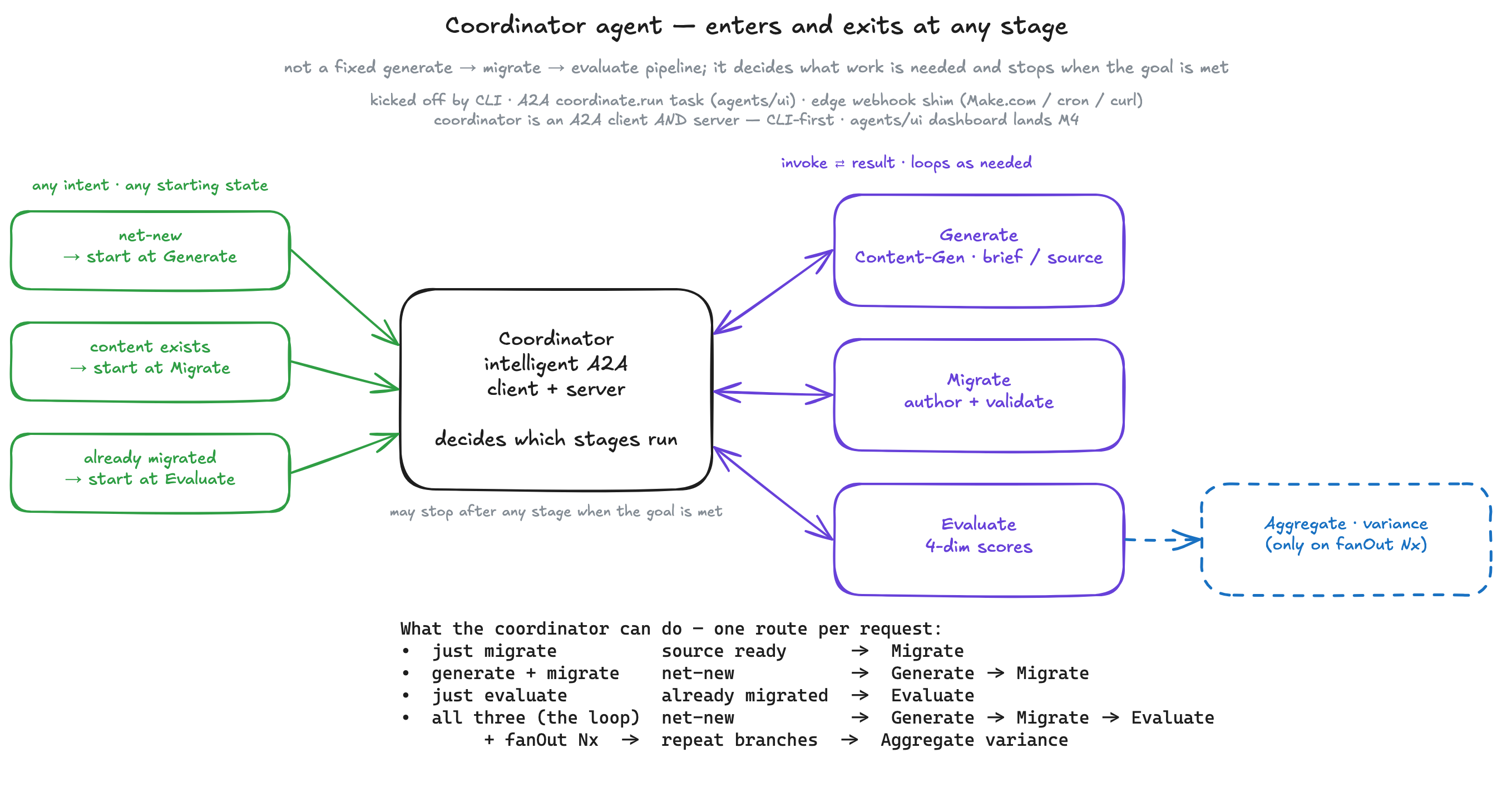
The closed loop, from the repo's own docs. The coordinator can enter or exit the loop anywhere.
- 91 eval score on a real Kimi-authored page
- ~9 min for a real agentic migration
- ~11 min full closed loop, real everything
- 4/4 cloud acceptance, e2e
The through-line, v1.0 → v2.5 · the biggest single component
The eval outlived both architectures
If agents author content, something has to say whether it's good. That something gets versioned, deployed, and tested like a product of its own.
Four dimensions: structure, accessibility, content fidelity, visual correctness. In v1 the eval shipped as its own Docker container. In v2 it became an agent in the mesh, so every migration lands with a score attached. The payoff came in v2.5, when the numbers said the site redesign was failing: the error turned out to be in the eval's own methodology, and scoring generated pages on their own merits moved a real article from 67 to 89. Numbers you can argue with beat vibes you can't.
Jun 18, 2026 · v2.2 · the factory runs daily
A daily unattended run
A daily cron submits a run with no topic. The coordinator ideates one, generates, migrates, evaluates, and parks it in preview. A human curates later.
Two lessons came out of production. Streams die crossing the Worker-to-container hop, so the store, not the stream, is the contract: every agent persists full task state and consumers recover by polling. And containers get no native database bindings, so the Worker proxies queries.
- 20.6K lines of TypeScript
- 27 e2e files · no mocks, ever
- 5 JSON Schema contracts
Dec 2025 - Jan 2026 · v1.0 as designed · recovered from git
The v1 platform, in its planned final form
Five subsystems around one EDS site. Color is the semantic axis this page's diagrams still use: deterministic in blue, agentic in red, mixed in purple.
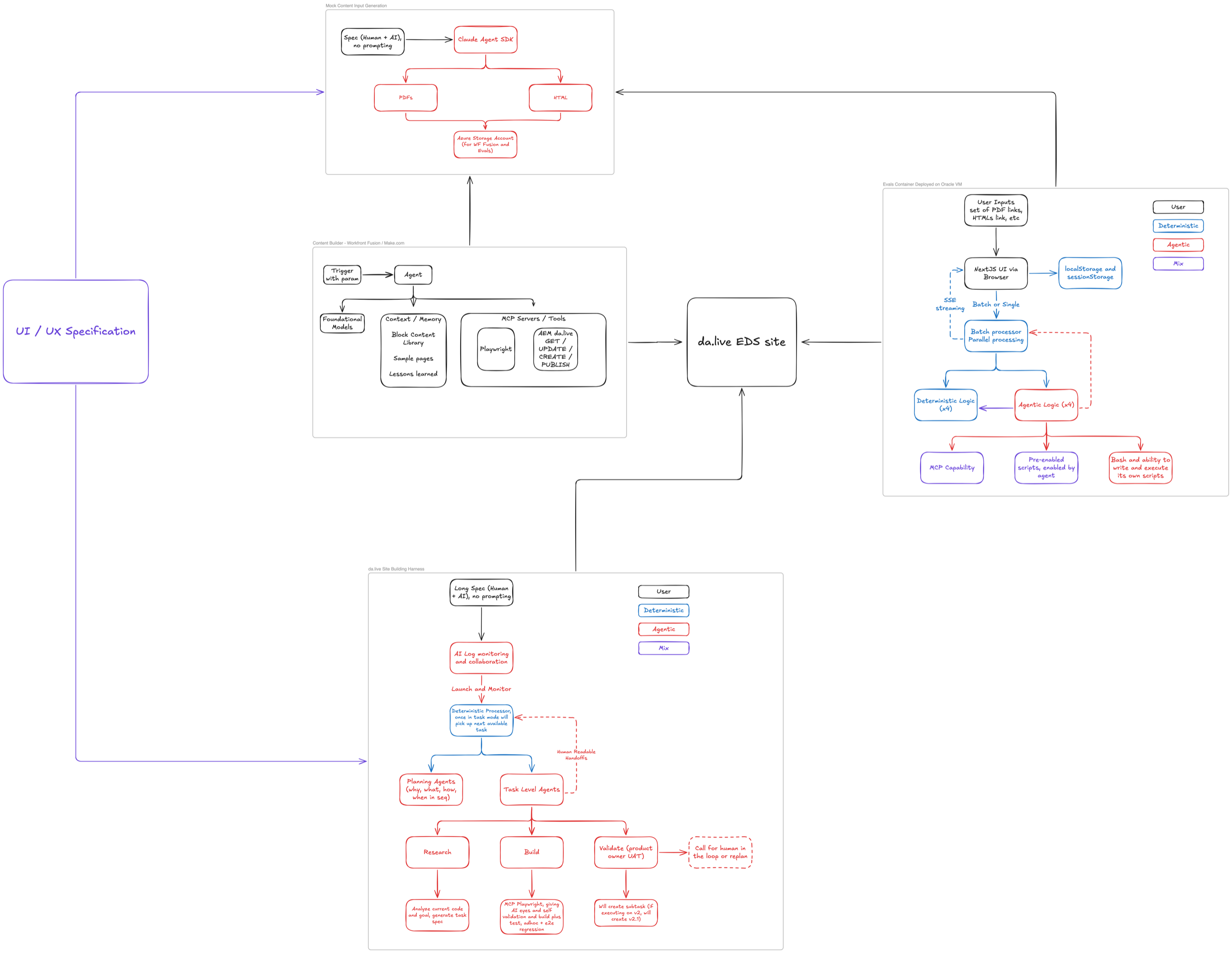
Drawn while v1 was being built: Agent SDK content generation, a Make.com builder over MCP, the evals container, and the site-building harness. The Excalidraw was later recovered from git history.
Oct 2025 · where this repo started
First, AEM content operations became tool calls
The origin build: an MCP server for AEM's da.live, then the same server proven from Claude, Gemini, Azure OpenAI, and n8n. No client-specific forks.
The repo's first life was interoperability with the CMS I work on professionally: expose AEM Edge Delivery's content operations, get, update, create, publish, over MCP once, and every agent that speaks the protocol inherits them. Everything else in this chapter stands on that server. The mesh grew out of asking what happens when the agents themselves get addresses too.