Continuous Executive Agent
A 24/7 coding agent
Jan 24 - May 31, 2026 · 374 commits · 16 releases · ran 24/7 for four months
incremental specs to build it: a dated spec and plan per release, ai-docs v1 through v3. dark factory when it ran: nobody watched the overnight builds.
A coding agent that runs around the clock under PM2. It selects work from a priority queue, spawns isolated workers, validates with deterministic verifiers, retries with a different strategy on each failure, and escalates to a human only when stuck.
This section goes release by release: a foundation era, an identity-and-multi-vendor era, and a memory era. Four months. The output repo ended up with thirty projects, most of them built overnight.
- 571 worker contracts
- 41 goals completed autonomously
- 30 projects built
- 3338 verifier runs
- 8 human interventions, total
v1.0.0 → v3.0.0 · 16 tags
Release history
Dates from git tags. Summaries from the changelog.
Jan 24, 2026 · built in a single day
Foundation
The 8-phase executive loop. Two-repo architecture: the brain never receives worker output. A constitution of 8 immutable limits, including a $20/month spend cap. Contracts, deterministic verifiers, PM2, append-only ledgers.
Jan 25, 2026
Intelligence
Goals over 100 turns auto-split into steps. Strategy rotation: every retry must try something different. Agentic diagnosis after three failures. The needs-you.md protocol: I answer in a markdown table, it notices within thirty seconds.
Jan 28, 2026
Organization
Goal bundles: each goal a directory with its own prompt, machine-readable steps, contract log, and progress log. Workspace lifecycle drafts → ondeck → in-progress → completed, promoted by priority.
Feb 4, 2026
Security
Three physically separated credential tiers with leak detection on every spawn. OAuth-first: the whole system runs on a Claude subscription, no API key.
Mar 29, 2026
Identity: the agent gets its own accounts
Its own Gmail: it receives goals by email. Its own Discord: it reports completions and blocks. Skills and playbooks with a track record: every skill carries a success rate. A read-only dashboard. I became a guest in my agent's workspace.
Apr 1 - 5, 2026
Multi-vendor: the bake-off
A vendor abstraction layer: Claude, OpenAI Codex, and Kimi workers behind one interface. Then the experiment: the same finance-dashboard spec run across all four vendor modes, deployed live, and scored by the harness itself.
Apr 12, 2026
Harness framework
Three multi-agent plan-then-build pipelines became first-class citizens, runnable standalone or driven by the executive. 105 passing tests; the whole orchestrator exercised end-to-end in about a second with zero API calls.
Apr 18 - 19, 2026
Build targets & hard lessons
Worktree isolation per project. Progressive skill disclosure with a verifier that fails a contract if a required skill was never consulted. And a favorite war story: a prompt saying "No UI, no database" got post-processed into a plan whose step zero provisioned database tables. The hallucinating prerequisite-inserter was found and fixed.
May 31, 2026
Memory
A mem0-backed second brain. Five memory types, five lifecycle hooks, memory packs baked into each worker's context, ~134 memories backfilled. Git stays canonical: if the store and the repo disagree, the repo wins. The riskiest hook stayed off until the memories earned trust.
Apr 6, 2026 · demoed live at AI Tinkerers Columbus
The multi-vendor bake-off
Same spec, four vendor modes, seven verifiers each. The harness did the scoring.
Demoed on the running system, no slides. One night that week the ledger shows Codex finishing its build and passing validation at 3:56 AM, with nobody awake. The demo video shown was produced by the agent end to end: 81 seconds, zero keystrokes.
"Is it perfect? No. Is it close? Also no. But I'm proud of where it's at."
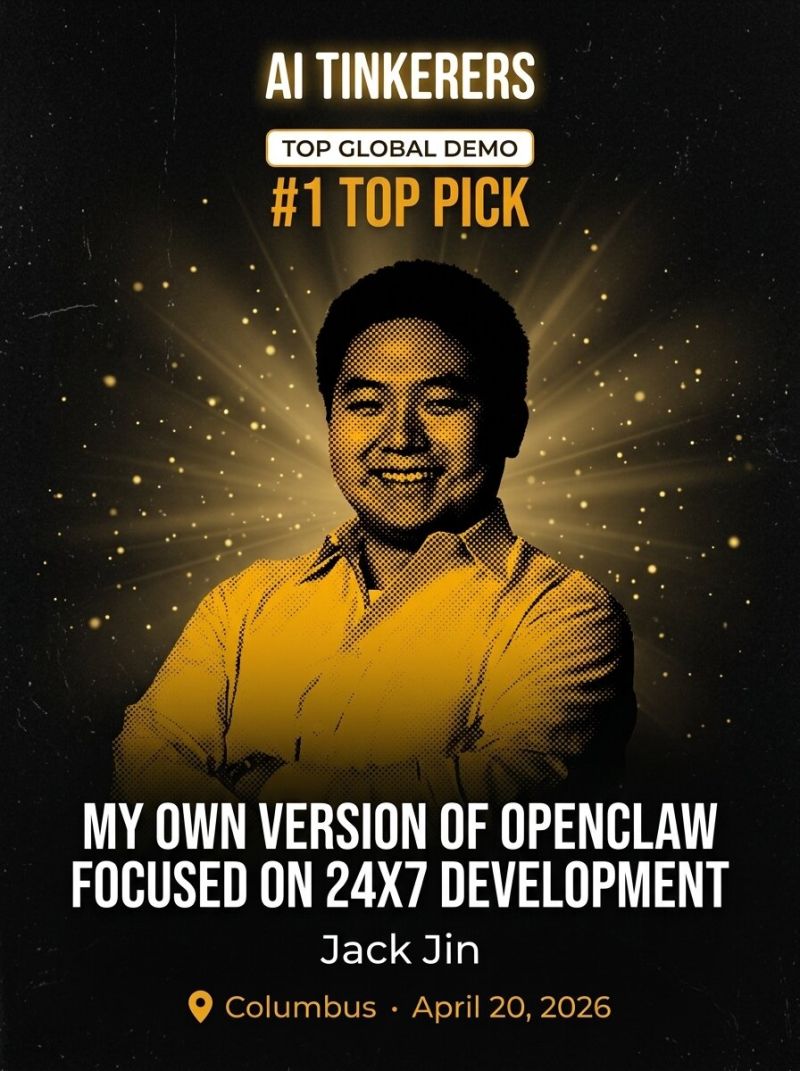
Two weeks later, AI Tinkerers picked the demo as their #1 top pick globally that week and made this graphic. Their design, not mine.
Mar - Apr 2026 · the identity era, up close
Its own Gmail, Discord, and Notion
An always-on agent needs its own accounts, not borrowed ones.
It receives goals by email and reports to its own Discord channel. I am a guest in the agent's workspace, and the working rhythm is reading the overnight commits in the morning. Human interaction is markdown files, not a chat box waiting for input.
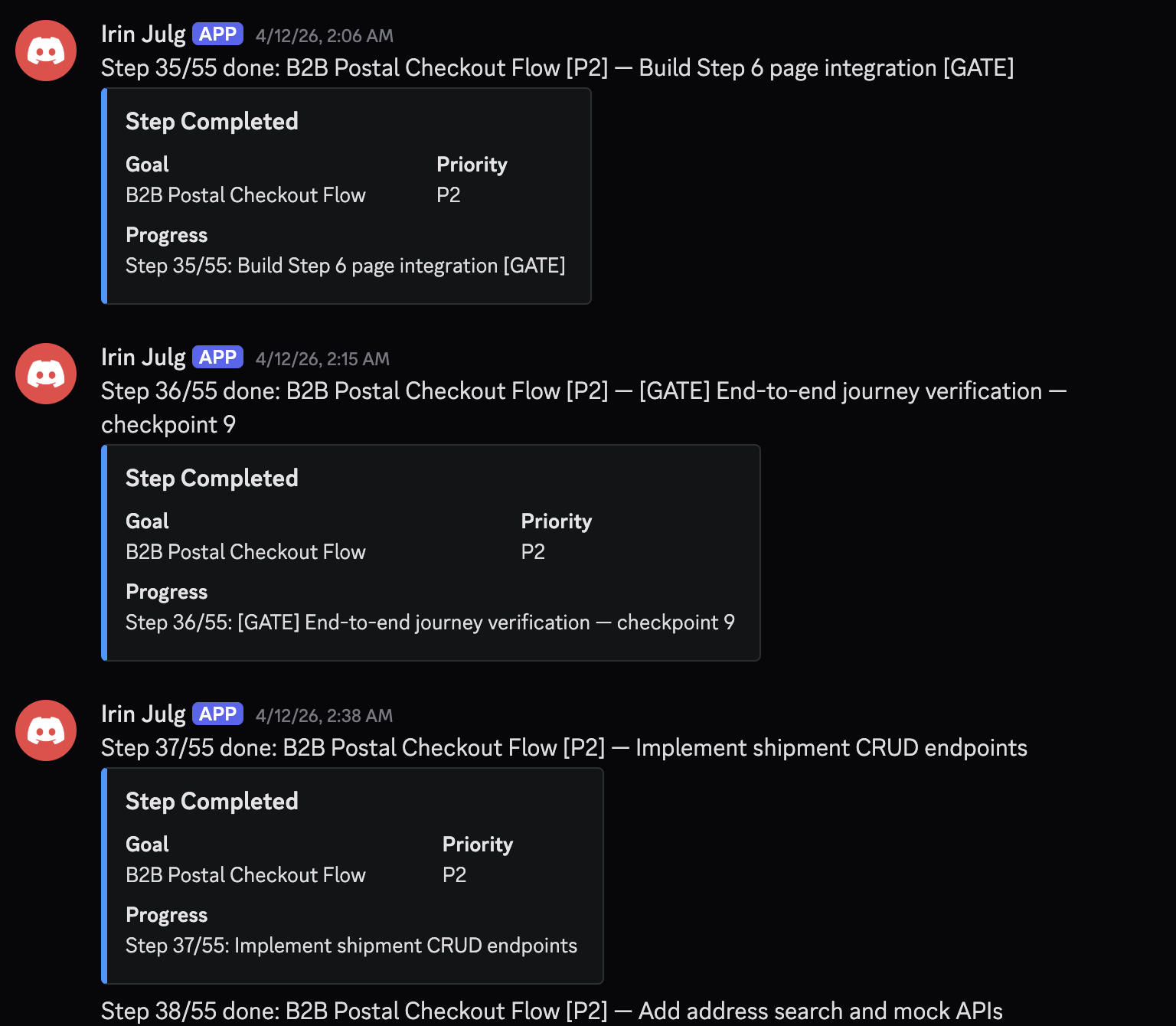
The agent's own Discord. I read it like a colleague's channel.
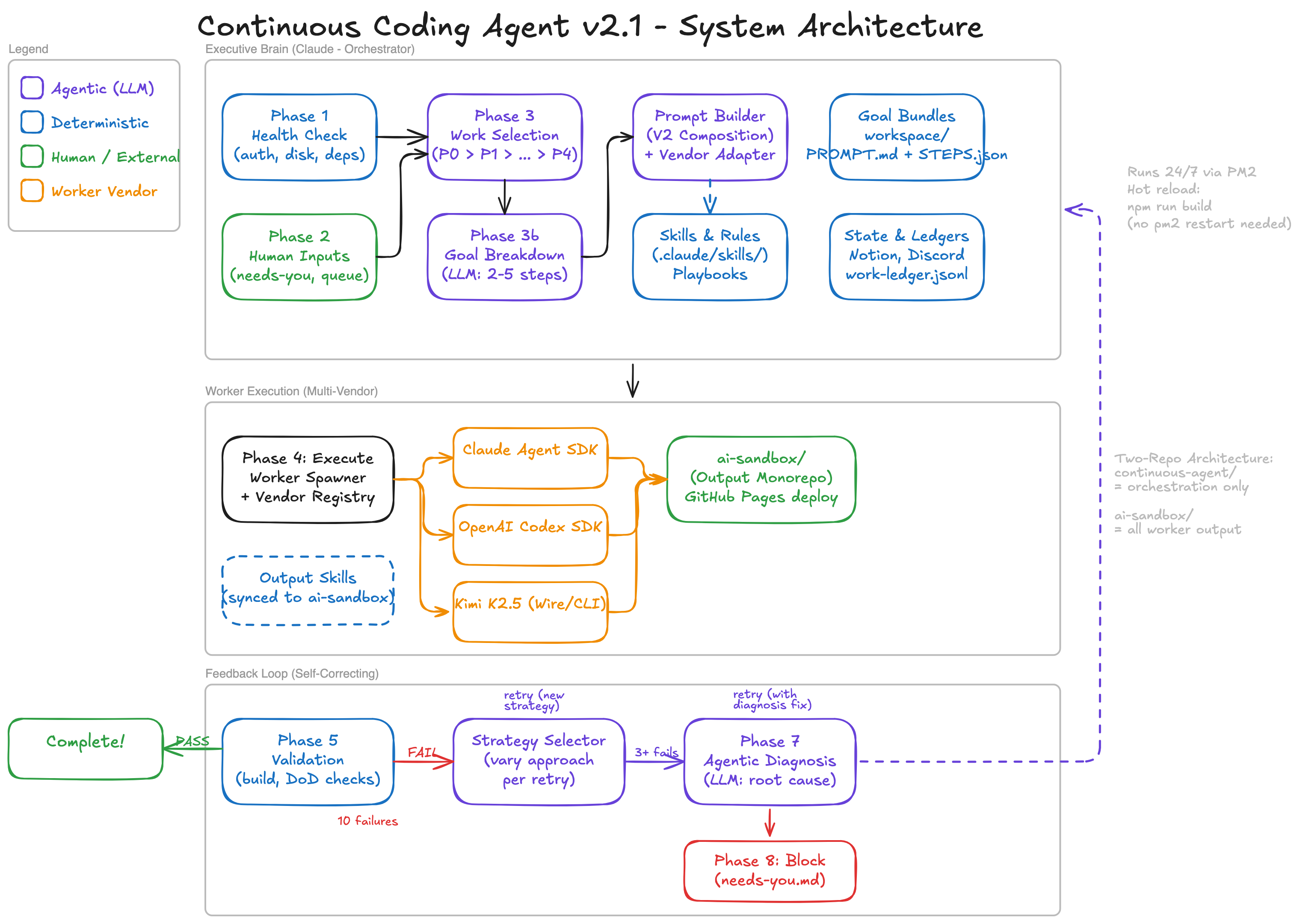
The v2.1 system map, hand-drawn: executive brain, worker execution, feedback loop.
May 31, 2026 · v3.0 · the closing release
The agent gets a second brain
Storage is the easy half. Retrieval decides whether a memory was ever real.
Five memory types, from immutable principles to reflective lessons. Workers never touch the store: they get a curated, two-thousand-token memory pack baked into their context. The best war story is the silent bug: an empty-string config value made every single write fail while the logs said "ok." Found, fixed, and the logging redesigned so a total failure can never look like success again.
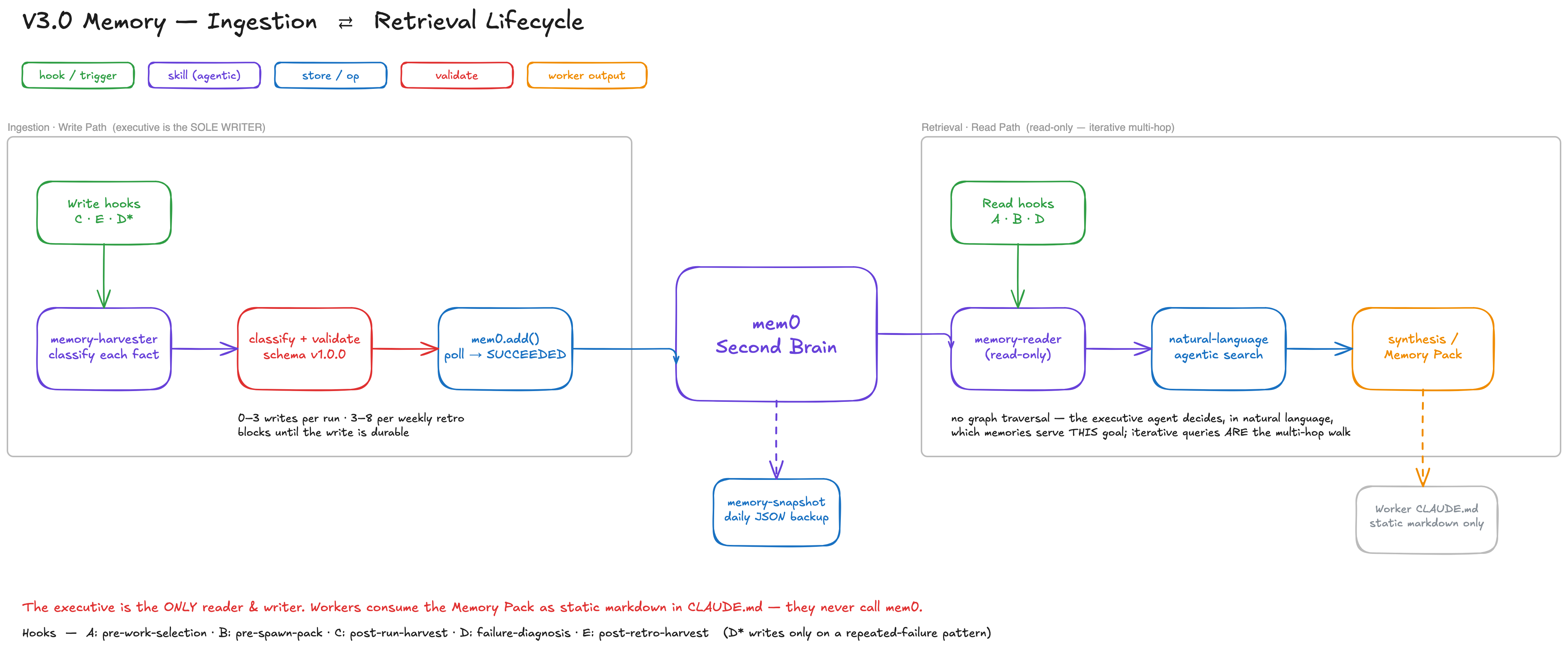
The write path and the read path. One writer, one reader, no agent scribbles wherever it wants.
The roadmap said multi-agent
The v3.0 deck closes with "Multi-Agent (V4.0): parallel agents, partitioned scope." That version was never tagged here.
It shipped as a different repo
Five weeks after v3.0, Anima Mesh's first commit landed. The founding document names this system as its predecessor. The monolith's V4 is the mesh at the top of this page.