Anima Mesh
The company-of-0 experiment
Jul - Aug 2026 · 2 repos
ad hoc no spec preceded the code. The structure came from releases: 38 tags through v0.16.2, a changelog per minor line, and platform failures written down as learnings.
AnimaMesh runs recurring back-office work from a private repo: compliance checks, bookkeeping prep, document memory, governance, research, and inbound triage. A human remains the approval gate for money, filings, publishing, credentials, and access.
Cloud execution is primary. A Worker reads the brain as one tarball, runs the agents that are due, verifies their artifacts, and lands one commit before a brief or reply is sent. The CLI uses the same engine for setup, recovery, and subprocess-only harnesses.
Engine source, public
github.com/jackzhaojin/anima-mesh ↗
Apache 2.0 · v0.16.2 · TypeScript on Cloudflare Workers · the company brain stays private
v0.16.0 · Cloudflare Workers + Durable Objects + GitHub
Cloud first, one private brain per instance
Durable Objects hold alarms, locks, queues, and budgets. The private GitHub repo holds knowledge and evidence. Read sources stay external.
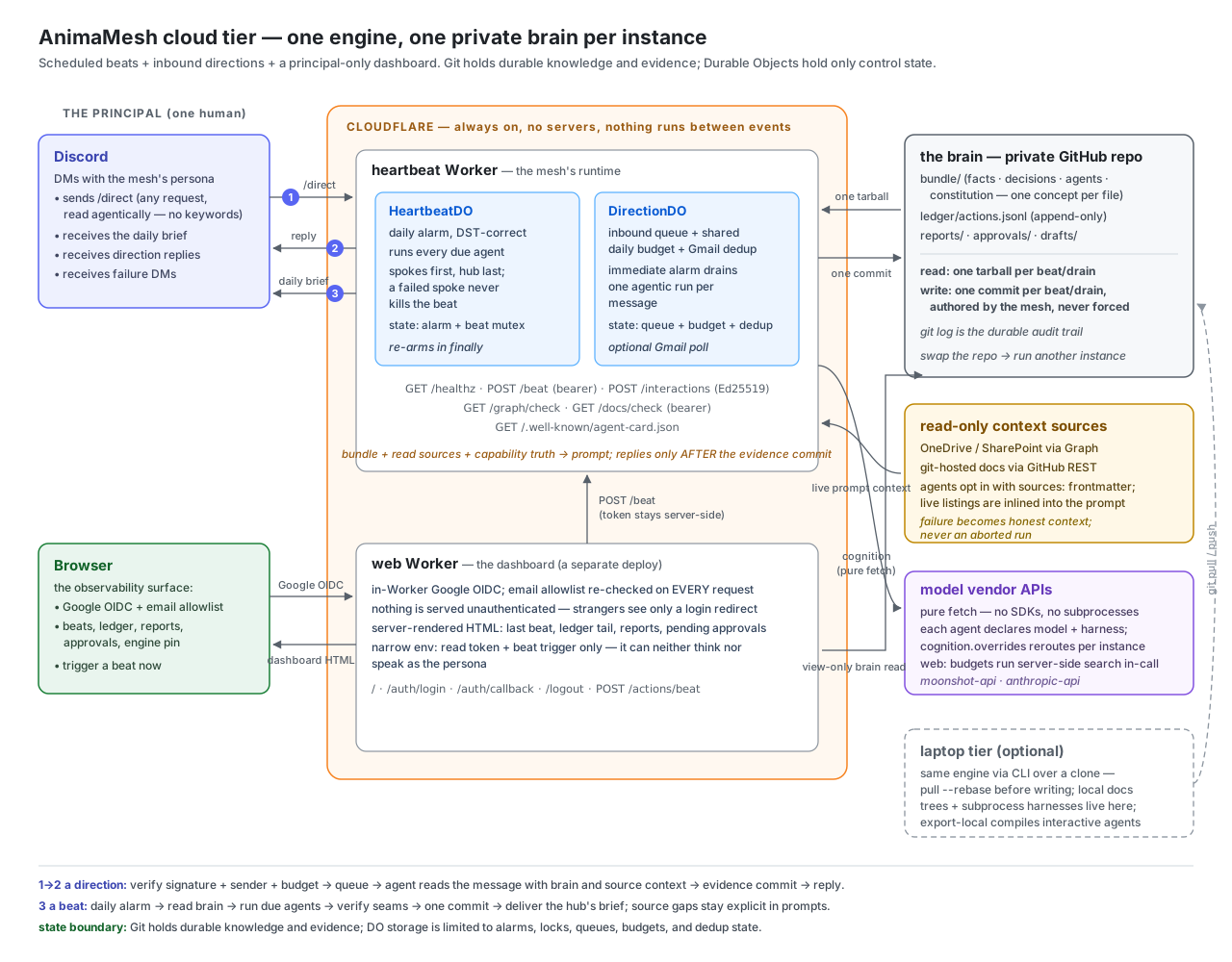
The normal operating path. The cloud tier runs while the laptop is closed; the laptop tier remains available for local tools and recovery.
Repository SVGs · synced with the Aug 2 implementation
Six views of the same system
State, reach, runtime, feedback, staffing, and ownership. Each view follows a seam that exists in the code.
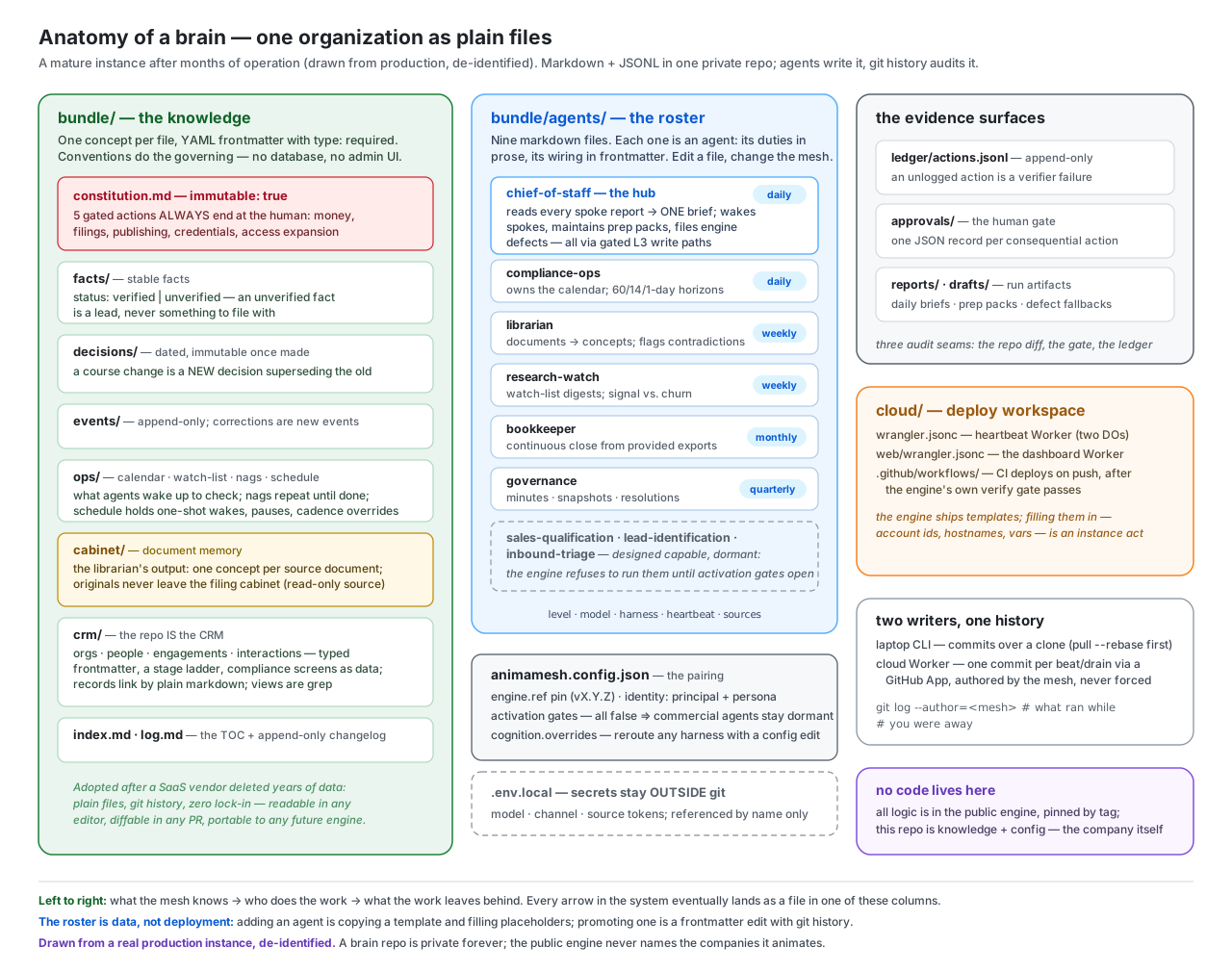
01 · state
One organization as plain files
Knowledge, agent definitions, deploy configuration, approvals, reports, and an append-only ledger live in one private repo. No engine code lives there.
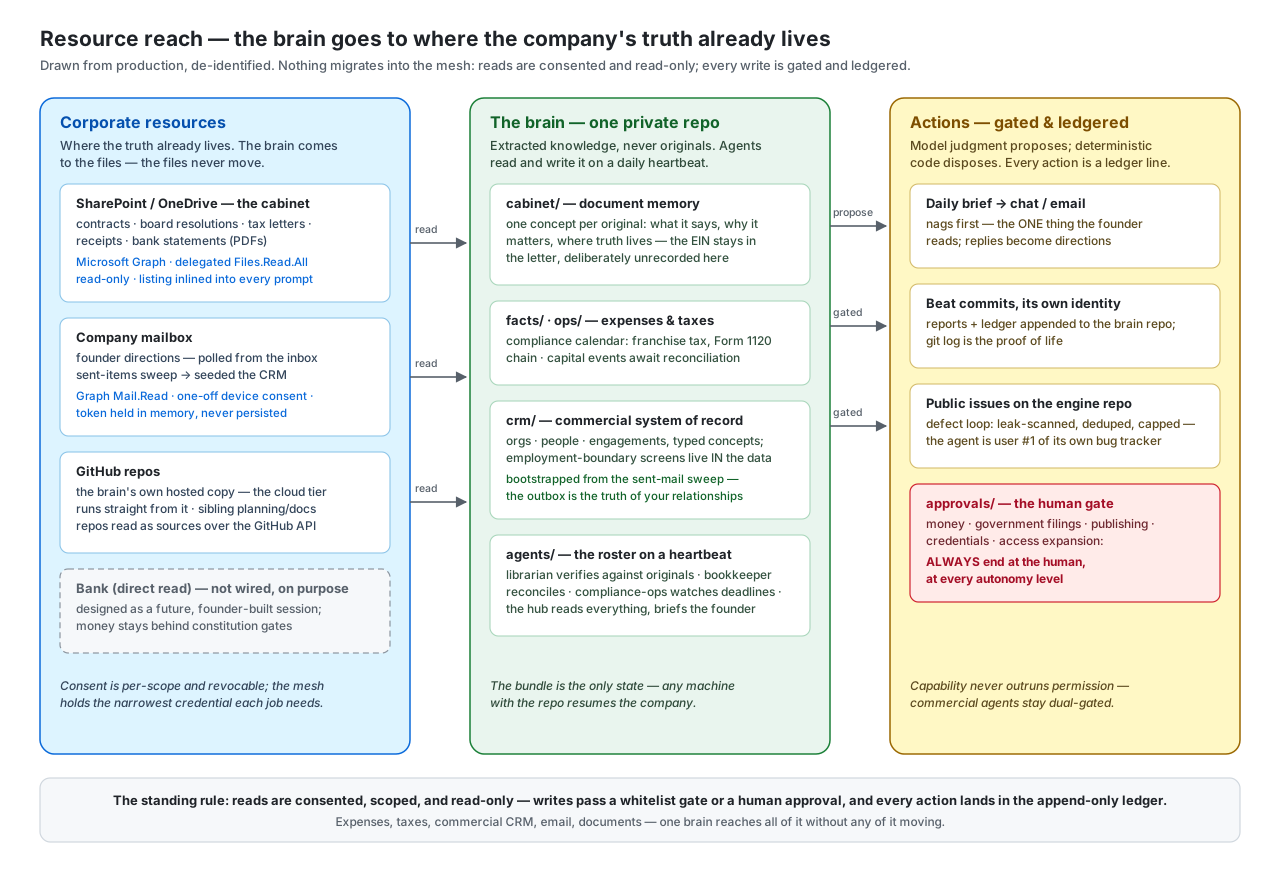
02 · reach
The files stay where their truth already lives
SharePoint, mail, and GitHub are scoped inputs. Reads are consented and read-only; writes pass a deterministic gate and land in the ledger.
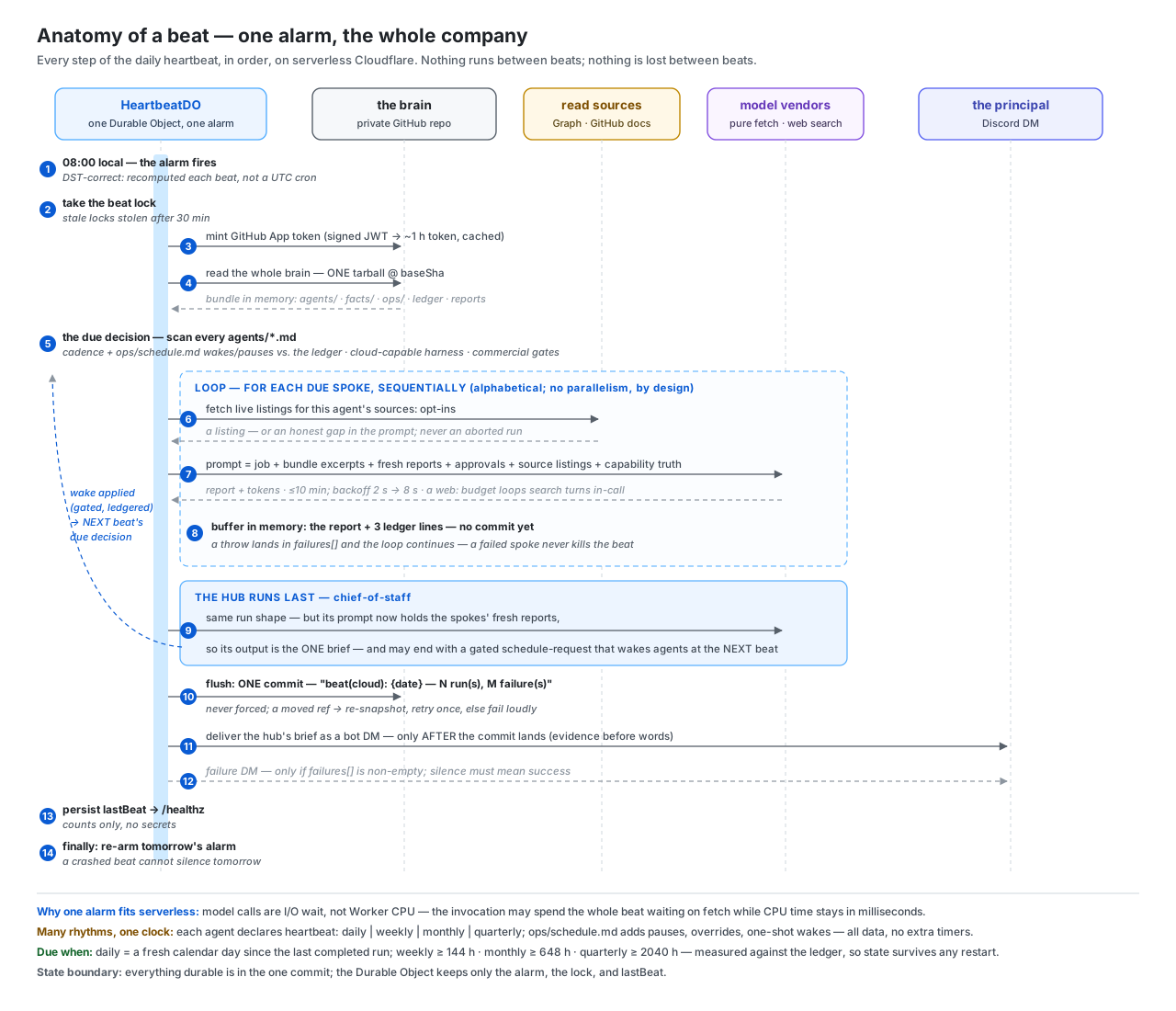
03 · runtime
One alarm, then one evidence commit
The beat reads the whole brain, runs due spokes sequentially, runs the hub last, commits once, and only then sends the brief.
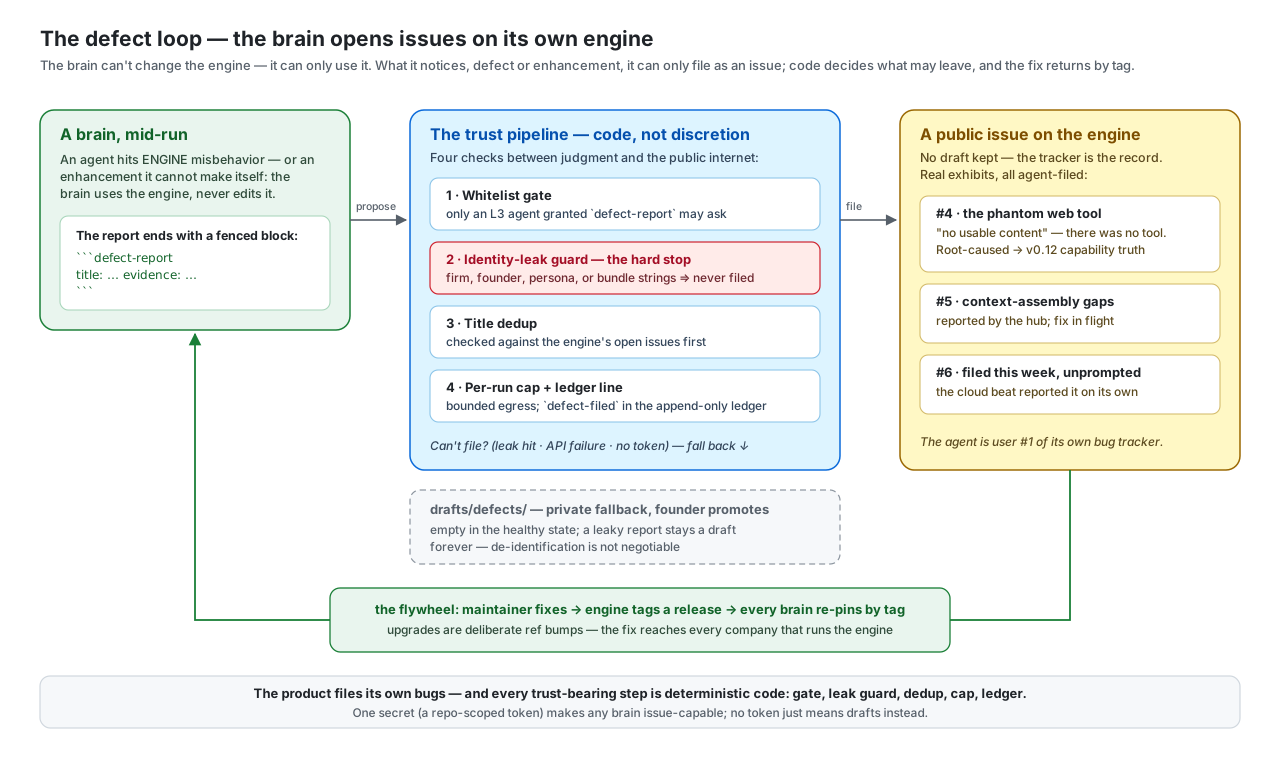
04 · feedback
The brain reports defects on its own engine
A gated report crosses a leak guard, title deduplication, and a per-run cap before it becomes a public issue. The fix returns through a tagged engine release.
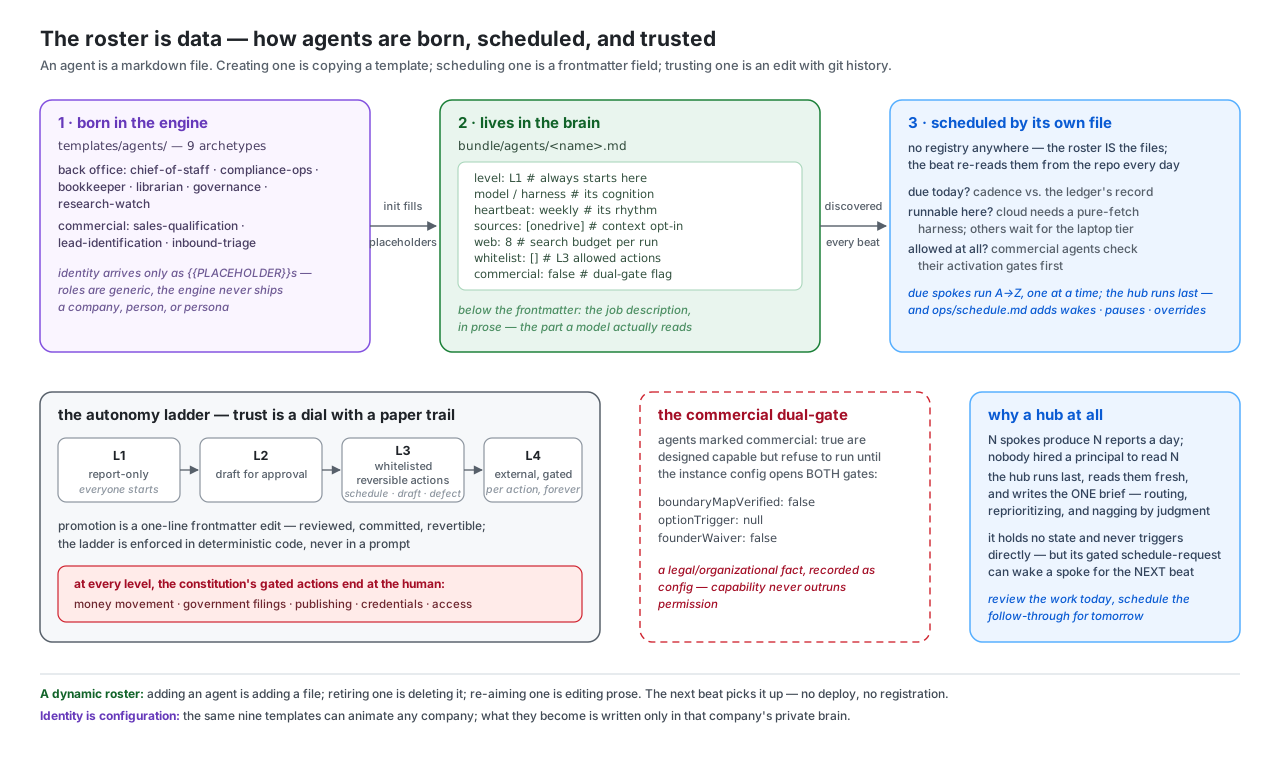
05 · staffing
The roster is data, not deployment
Each agent is frontmatter plus prose. Its file carries model, harness, rhythm, sources, read paths, web budget, whitelist, and autonomy level.
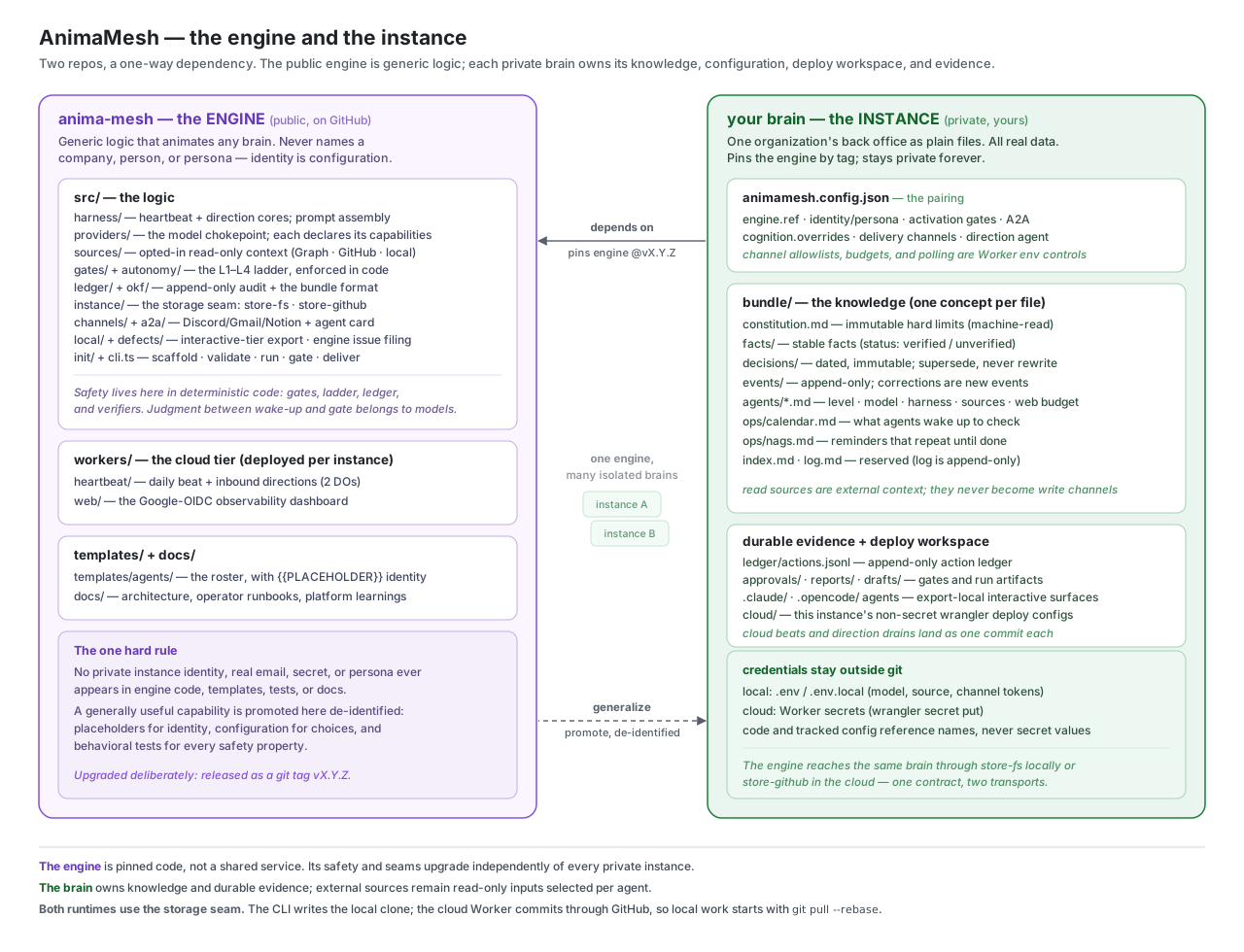
06 · ownership
Generic engine, isolated company state
The public repo owns reusable logic and tests. Each private instance owns identity, knowledge, credential bindings, deploy configuration, and durable evidence.
Running since Jul 6, 2026 · cloud primary since Jul 11
Nine agents, one approval gate
From the docs: "the initiative inverts: you stop driving the operations and start reviewing them."
Nine agent concepts run on daily, weekly, monthly, and quarterly rhythms. Due spokes run sequentially; the hub runs last and reads their fresh reports. Discord and Gmail feed direction runs. A separately credentialed dashboard shows the evidence and can trigger a beat. Role-declared reads: paths are inlined into every prompt, with missing context named instead of silently dropped.
"A reply that isn't backed by a commit is a hallucination with a send button."
- 330 ledger entries
- 81 agent reports
- 38 commits by the mesh
- 9 agents on roster
brain · private by design38 tags through v0.16.2 · Apache-2.0
Safety lives in code, never in prompts
Everything between wake-up and gate is model judgment. Gates, ladder, ledger, and verifiers are deterministic code.
Five constitutionally gated action classes cover money movement, government filings, publishing, credentials, and access expansion. Three reversible write paths ship today: schedule updates, draft writes, and defect reports. Each request is parsed, checked against the same ladder and whitelist gate, and ledgered whether applied or denied.
- 3 gated write paths
- 2 fetch-only cloud harnesses
- 1 evidence commit per beat or drain
Four coordination approaches
Three coordinator systems came before it, each with a different coupling: the continuous agent below, a tightly coupled monolith; the conversion factory's hub and four spokes; and the content factory's loosely coupled A2A mesh. Anima Mesh is the extracted lesson: keep coordination in shared state and model judgment, while deterministic code owns gates, ledgers, verification, and scheduling.
Operational evidence
The private brain records 38 commits authored by the mesh, 330 append-only ledger entries, and 81 reports since July 6. The cloud schedule and the repo history are the evidence surfaces; the portfolio only summarizes them.